
OCP Summit 2025: The Open Future of Networking Hardware for AI
- At Open Compute Project Summit (OCP) 2025, we’re sharing details about the direction of next-generation network fabrics for our AI training clusters.
- We’ve expanded our network hardware portfolio and are contributing new disaggregated network platforms to OCP.
- We look forward to continued collaboration with OCP to open designs for racks, servers, storage boxes, and motherboards to benefit companies of all sizes across the industry.
At Meta, we believe that open hardware is a catalyst for innovation — especially as data center infrastructure increasingly supports new and emerging AI technologies. Open hardware plays a crucial role in enabling disaggregation, allowing us to break down traditional data center technologies into their core components. This approach empowers us to build systems that are more flexible, scalable, and efficient.
Since co-founding the Open Compute Project (OCP) in 2011, Meta has shared data center and component designs, and open-sourced our network operating system, FBOSS, to inspire new ideas both within our own operations and across the industry. These efforts have played an important role in making Meta’s data centers sustainable and efficient. Today, through OCP, we continue to advance open network technologies for the next generation of AI applications.
We’re announcing several new milestones for our data center networking:
- The evolution of Disaggregated Scheduled Fabric (DSF) to support scale-out interconnect for large AI clusters that span entire data center buildings.
- A new Non-Scheduled Fabric (NSF) architecture based entirely on shallow-buffer, disaggregated Ethernet switches that will support our largest AI clusters like Prometheus.
- The addition of Minipack3N, based on NVIDIA’s Ethernet Spectrum-4 ASIC, to our portfolio of 51 Tbps OCP switches that use OCP’s SAI and Meta’s FBOSS software stack.
- The launch of the Ethernet for Scale-Up Networking (ESUN) initiative, where Meta has worked with other large-scale operators and leading Ethernet vendors to advance using Ethernet for scale-up networking (specifically the high-performance interconnects required for next-generation AI accelerator architectures..
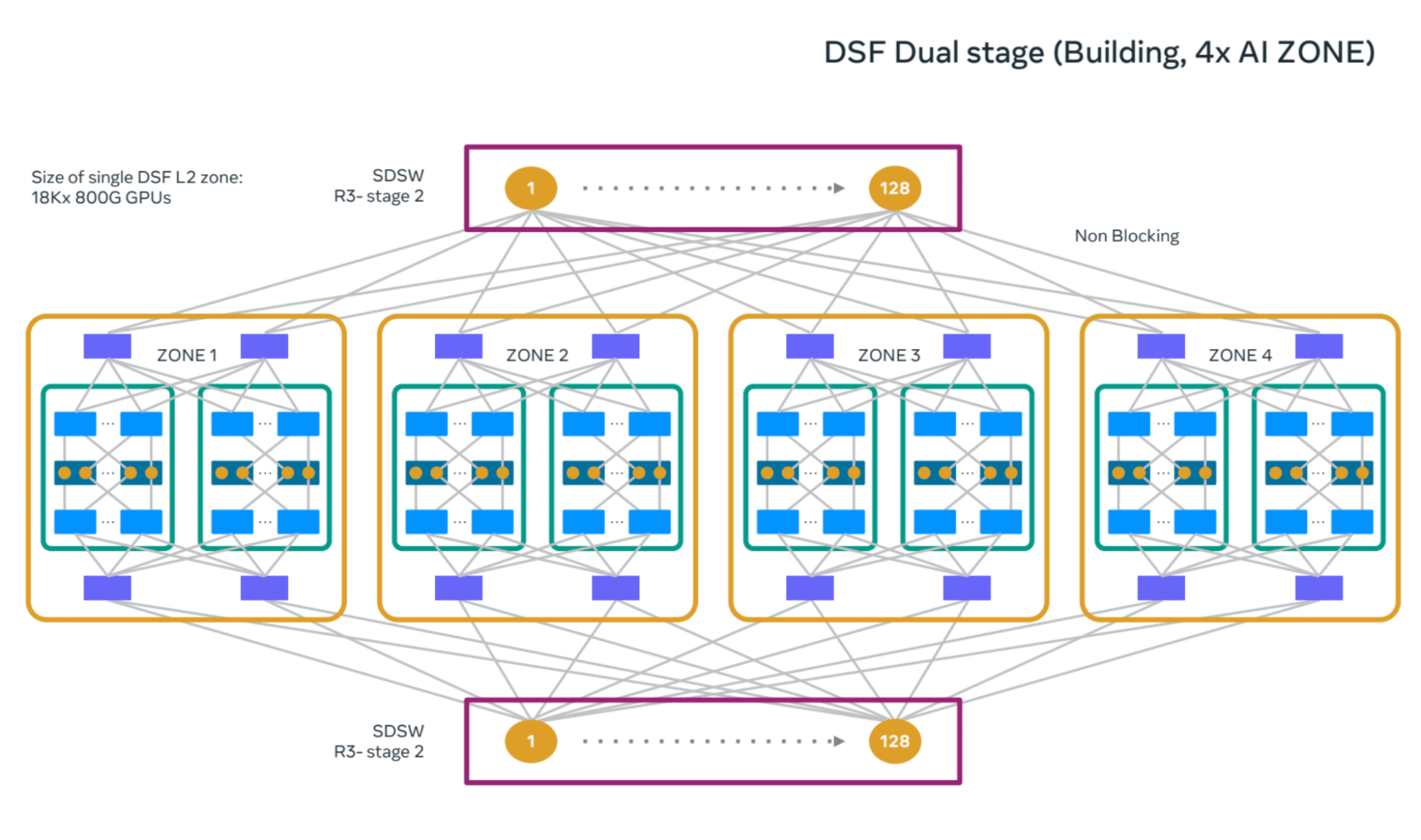
Dual-Stage DSF: Scaling Scheduled Fabrics for Larger AI Clusters
At last year’s OCP Global Summit we shared Disaggregated Scheduled Fabric (DSF), a VOQ-based system powered by the open OCP-SAI standard and FBOSS. The DSF fabric supports an open and standard Ethernet-based RoCE interface to endpoints and accelerators across several xPUs and NICs, including Meta’s MTIA as well as from several vendors.
Over the last year, we have evolved DSF to a 2-stage architecture, scaling to support a non-blocking fabric that interconnects up to 18,432 XPUs. These clusters are a fundamental building block for constructing AI clusters that span regions (and even multiple regions) in order to meet the increased capacity and performance demands of Meta’s AI workloads.
Non-Scheduled Fabrics (NSF) for Large AI Clusters
In parallel with the evolution of the DSF architecture, we have also devised a new architecture called the Non-Scheduled Fabric (NSF), with the following key features:
- Based on shallow-buffer OCP Ethernet switches.
- Delivers low round-trip latency.
- Supports adaptive routing for effective load-balancing, ensuring optimal utilization and minimizing congestion.
- Serves as foundational building block for Gigawatt-scale AI clusters like Prometheus.

New OCP Switch Platforms for Next-Generation AI Fabrics
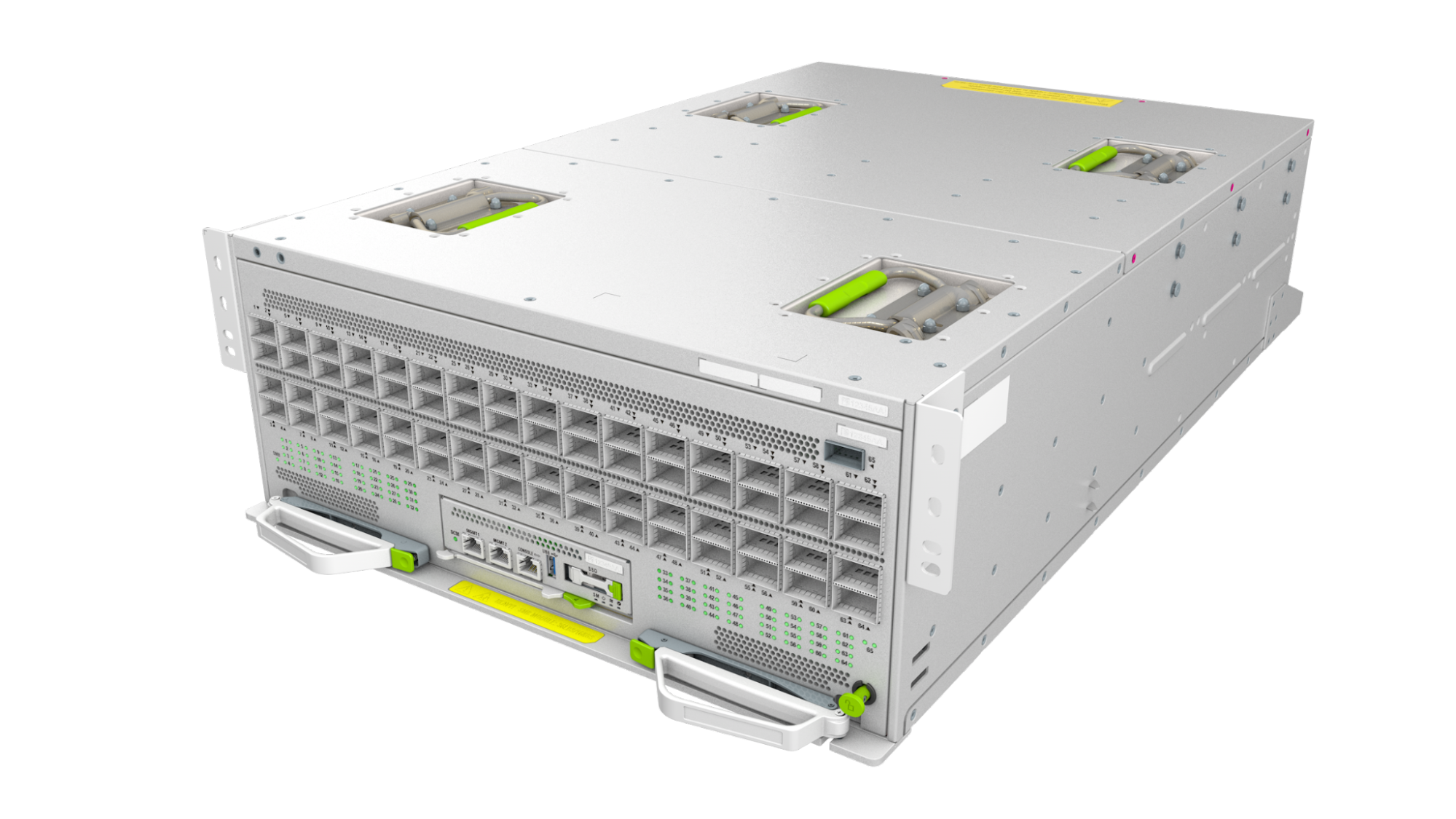
Last year, Meta introduced two new 51T Ethernet switches: Minipack3 (based on Broadcom Tomahawk5) and Cisco 8501 (based on Cisco Silicon One G200). These OCP switches offer 51.2 Tbps (64x OSFP ports), are power-efficient without the need for retimers, and run our large-scale network operating system, FBOSS. These platforms have served as the foundation for building our next-generation frontend and backend data center fabrics.
This year, we are introducing Minipack3N, a new 51T Ethernet switch that is based on the NVIDIA Spectrum-4 switching ASIC and leverages the same system design as Minipack3.
Evolving FBOSS and SAI for DSF and NSF

Meta continues to embrace OCP-SAI as the foundation for onboarding new network fabrics, switch hardware platforms, and optical transceivers into FBOSS. Through close collaboration with vendors and the OCP community, we have evolved SAI to support advanced features and concepts, including DSF, NSF, and other enhanced routing schemes tailored for modern data center and AI workloads.
This open approach empowers developers and engineers worldwide to engage with cutting-edge hardware, contribute innovative software, and leverage these solutions for their own needs. By sharing advancements and fostering collaboration, we help accelerate progress across the industry, ensuring that open hardware and software remain at the heart of scalable, efficient, and future-ready data center infrastructure.
Optics: 2x400G FR4-LITE and 400G/2x400G DR4 Optics for 400G/800G Optical Interconnections
Last year, Meta introduced 2x400G FR4 BASE (3-km) optics, the primary solution supporting next-generation 51T platforms across both backend and frontend networks and DSFs. These optics have now been widely deployed throughout Meta’s data centers.
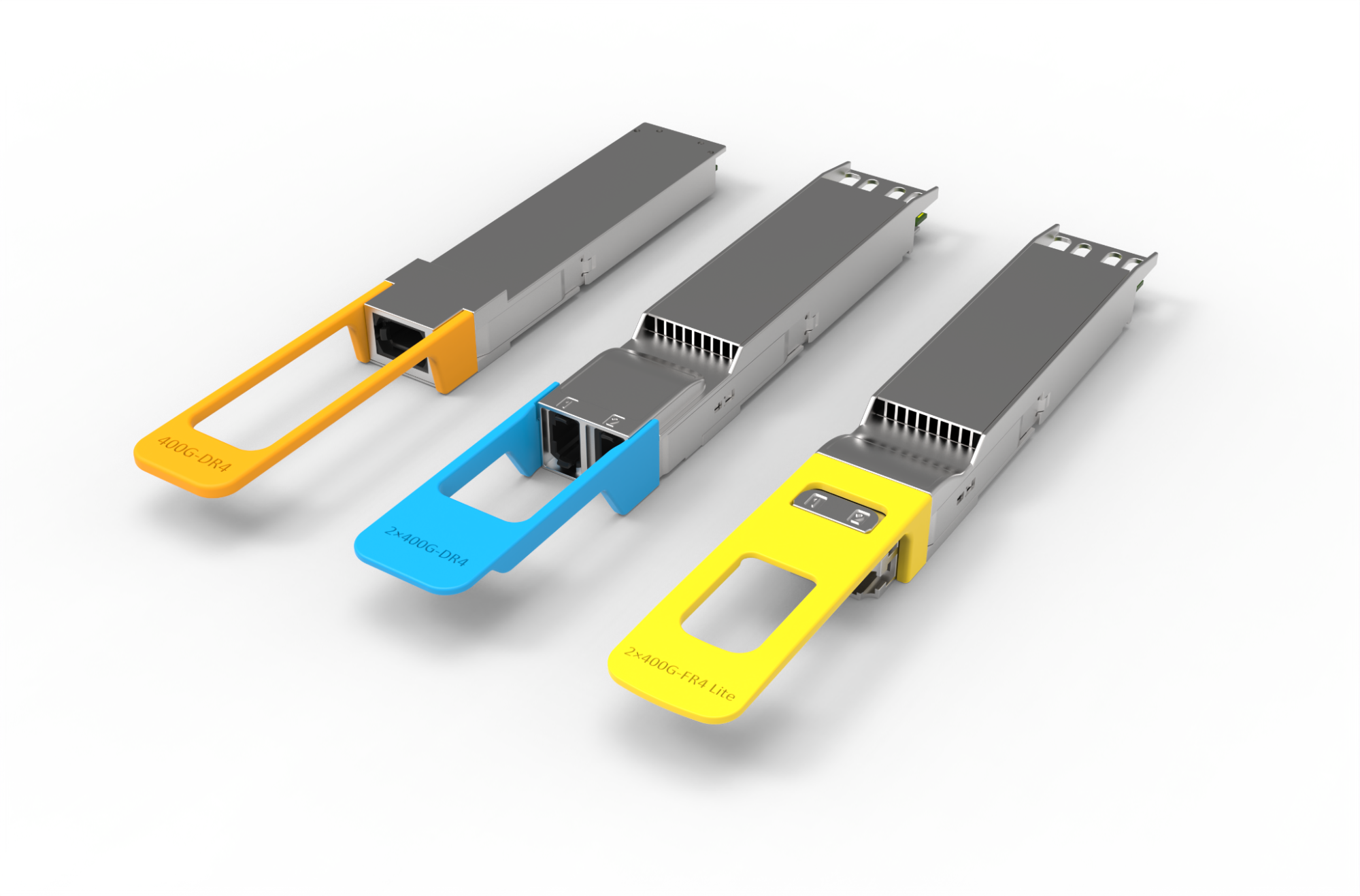
This year, we are expanding our portfolio with the launch of 2x400G FR4 LITE (500-m) optics. Developed as part of an efficiency initiative, FR4 LITE is optimized for the majority of intra–data center use cases, supporting fiber links up to 500 meters. This new variant is designed to accelerate optics cost reduction while maintaining robust performance for shorter-reach applications.
In addition, we are introducing the 400G DR4 OSFP-RHS optics — our first-generation DR4 solution for AI host-side NIC connectivity. Complementing this, the new 2x400G DR4 OSFP optics are being deployed on the switch side, providing connectivity from host to switch.
Ethernet for Scale-Up Networking in OCP: Meta’s Industry Leadership
At Meta, we recognize that the future of AI and data center infrastructure depends on open, scalable, and interoperable networking solutions. As part of our ongoing commitment to open hardware and industry collaboration, Meta is a founding participant in the new Ethernet for Scale-Up Networking (ESUN) initiative, which launched within OCP at the 2025 OCP Global Summit.
What Is ESUN?
ESUN is a new workstream within the OCP Networking Project. It functions as an open technical forum where industry operators and leading vendors can collaborate to advance the use of Ethernet technology. The specific goal of ESUN is to leverage and adapt the mature Ethernet ecosystem to meet the unique, high-performance demands of the scale-up domain within modern AI systems.
ESUN is focused specifically on the network functionality aspect of scale-up systems. The workstream is designed to address the technical challenges related to how data traffic is managed and transmitted across network switches. This includes defining best practices and standards for:
- Protocol headers
- Error handling mechanisms
- Achieving lossless data transfer across the network
The initiative brings together operators, vendors, and standards bodies to:
- Collaborate on Ethernet solutions tailored for scale-up networking.
- Focus on Ethernet framing and switching layers to ensure robust, lossless, and error-resilient multi-hop topologies.
- Align with open standards by working closely with organizations like UEC and IEEE.
Meta’s Contributions to ESUN
Meta is proud to be among the initial group of OCP members driving ESUN, alongside industry leaders that includes: AMD, Arista, ARM, Broadcom, Cisco, HPE, Marvell, Meta, Microsoft, NVIDIA, OpenAI, and Oracle.
Our contributions include:
- Technical leadership in defining the requirements for ESUN in AI clusters.
- Open collaboration with vendors and standards bodies to ensure that solutions are interoperable and not tied to proprietary technologies.
- Sharing best practices and lessons learned from deploying advanced Ethernet fabrics in Meta’s own data centers.,
An Industry Invitation: Join the Open Future
Driving progress in AI requires data center infrastructure that delivers more than just scale — it must also be flexible, efficient, and sustainable. At Meta, we envision a future where AI hardware systems are not only highly scalable, but also open and collaborative, enabling rapid innovation and adaptation to evolving workloads.
We invite engineers, developers, and industry partners to join us and the OCP community in shaping the next generation of networking hardware for AI. By working together and sharing ideas, we can accelerate the development of open, future-ready AI infrastructure that benefits the entire industry and supports the demands of tomorrow’s technologies.
The post OCP Summit 2025: The Open Future of Networking Hardware for AI appeared first on Engineering at Meta.
Login to comment
LoginRelated Conversations
-
10X Backbone: How Meta Is Scaling Backbone Connectivity for AI
0 Replies
-
How Meta Is Leveraging AI To Improve the Quality of Scope 3 Emission Estimates for IT Hardware
0 Replies
-
Design for Sustainability: New Design Principles for Reducing IT Hardware Emissions
0 Replies
-
Scaling LLM Inference: Innovations in Tensor Parallelism, Context Parallelism, and Expert Parallelism
0 Replies
-
Scaling Privacy Infrastructure for GenAI Product Innovation
0 Replies